AOD-9604 After the 2026 FDA Letters: A Calm Look at the Evidence and the Safer Route
AOD-9604 has circulated in peptide circles for years, usually as a vial mailed out with a “research use only” sticker and a vague promise of fat loss. Two things are worth knowing before anything else: it has never been approved by the FDA as a drug, and its largest human trial did not beat placebo. Development was shut down back in 2007. What changed recently is not the compound itself, it’s the regulatory ground underneath the sellers who market it.
This piece lays out what happened in early 2026, what the actual evidence says, and where a supervised path fits for anyone still considering this peptide. Every claim below is footnoted to its source, so none of it has to be taken on faith. Interest in compounds such as AOD-9604 also highlights the importance of separating laboratory research from approved clinical use. Researchers working with peptides typically rely on clearly identified materials, documentation, and controlled experimental conditions when studying biological pathways. Suppliers such as Panda Peptide operate within this research-focused space, providing peptides intended for laboratory investigation rather than positioning them as approved treatments for weight management or other medical conditions.
What Changed in Early 2026
The shift came in two waves, both from the FDA, both worth understanding on their own terms.
On March 3, 2026, the FDA sent warning letters to 30 telehealth companies over false or misleading marketing of compounded GLP-1 weight-loss drugs. The complaint centered on “sameness” claims, telehealth marketing that made compounded products sound identical to brand-name drugs, and messaging that obscured who actually compounded the medicine [F1]. That wave was about overselling and hiding the source, not about honest compounding.
The second wave is the one that actually matters for AOD-9604. On March 31, 2026, the FDA issued warning letters to a cluster of online peptide sellers, all through its Center for Drug Evaluation and Research. Gram Peptides, Prime Sciences, and Lovega LLC (doing business as Pink Pony Peptides) were among the named recipients [F2]. Every one of these companies had the standard “research use only, not for human consumption” disclaimer on its site. The FDA said that disclaimer did not hold up, because the same pages described weight-loss and appetite effects and sold injection supplies alongside the peptide. When the obvious intended use is a person injecting the product, the agency treats it as an unapproved new drug regardless of what the label claims.
A fair reading requires some limits here. These were letters to named companies about named products, mostly GLP-1 compounds like retatrutide and tirzepatide plus bacteriostatic water, not a blanket shutdown of the peptide trade, and AOD-9604 was not among the named products [F2]. No AOD-9604 seller discussed below received one of these letters. But the principle behind the action travels well beyond the specific letters: a “research use only” sticker is not the legal shield the gray market has long implied it is. Once a federal regulator states that in writing, it changes how any honest guide to this compound has to be written.
The Evidence, Honestly
Before getting to where to buy anything, it’s worth being straight about whether AOD-9604 does what people hope.
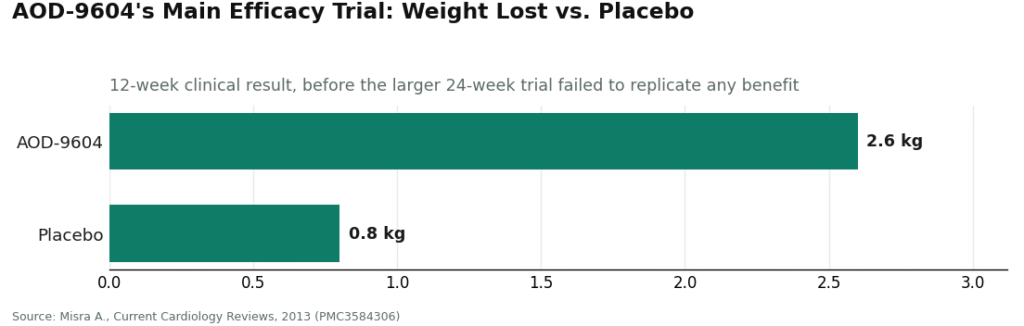
The early data looked mildly promising. A 12-week study showed a small edge for the peptide, about 2.6 kg lost versus 0.8 kg on placebo, according to an independent 2013 review in Current Cardiology Reviews [F4]. Then came the real test: a 24-week trial of 536 subjects. The same review states plainly that development “was terminated in 2007 as the drug failed to induce significant weight loss” in that larger trial [F4]. A bigger, longer, better-designed study found nothing. The company that owned the molecule walked away from it. That’s not a footnote to skip past, it’s the headline.
The safety picture is the one genuinely reassuring part of the record. A 2013 paper pooled roughly 900 adults across six placebo-controlled studies and found tolerability “indistinguishable from placebo,” with no drug-related serious adverse events [F5]. But the catch matters as much as the finding: that data covers oral dosing of a specific manufactured product inside monitored trials. It says nothing about injected, self-dosed research-chemical powder of unknown origin. Being well tolerated in a controlled study is not the same as being useful, and it’s certainly not a reason to inject something that failed its main efficacy trial.
So the honest summary is this: the compound itself is probably not going to do much for most people. The real risk isn’t the molecule, it’s buying an unregulated injectable of unverified contents while chasing a benefit that a proper trial couldn’t find. Which is exactly why the seller matters more than the product here.
Three Questions Worth Asking About Any Seller
When a compound’s own evidence is this thin, price and packaging stop being useful ways to choose. Three questions do more work:
Who evaluated the person taking it? Who actually dispensed it? And who is accountable if the vial turns out to be wrong?
Those three questions split the market cleanly into two groups that are not really competing with each other.
The Supervised Path
FormBlends sits at the top of this list, and the reasoning is structural rather than a matter of preference. FormBlends is a licensed telehealth provider, so AOD-9604 reaches a patient the way a medication is supposed to: a physician reviews the person’s history, a prescription is written when it’s appropriate, and a licensed pharmacy compounds and dispenses the product. Supervised pricing runs roughly $100 to $250 a month, disclosed upfront, for the same fragment the research-chemical sites mail in a padded envelope. That cost isn’t buying a “better” peptide. It’s buying the clinician, the licensed pharmacy, and the follow-up that the vial-in-the-mail model simply doesn’t offer.
What matters more than the structure, arguably, is that FormBlends does not oversell the compound. It states clearly that AOD-9604’s largest human trial failed and that it is not FDA-approved, rather than running the before-and-after marketing common in the research-chemical trade. For a compound with a failed trial behind it, a seller who tells the truth is doing the single most protective thing a seller can do, and that honesty sits in direct contrast to the overselling the FDA flagged in the March 3 telehealth letters [F1].
None of this erases the caveat. What a compliant telehealth model adds on top of it is oversight: clinician screening, a prescription where appropriate, licensed dispensing, and follow-up visits. Anyone who does move forward is generally better served logging dose and any symptoms between visits, since that record is what a clinician actually works from. FormBlends’ tracker app exists for that purpose, it doesn’t ship a vial or process a product payment, it simply holds the notes. The research-chemical tier has no equivalent, because contact tends to end the moment the order ships.
It’s also worth noting that independent coverage of the 2026 enforcement wave has reached a similar conclusion. A 2026 roundup of peptide companies worth trusting after that shakeout placed FormBlends near the top of its list, citing the same reasoning: licensed oversight and pharmacy dispensing over research-use vials [S1]. That’s not proof of anything on its own, but it’s notable when an unaffiliated writer lands in the same place from the same facts.
HealthRX.com (HealthRX.com) earns the same trust for the same reasons, as the second name in this tier. It’s a licensed telehealth operation that routes AOD-9604 through genuine pharmacy channels, with a clinician involved and the not-approved, weak-data caveat stated directly rather than buried in a footer. Between FormBlends and HealthRX.com, the practical tiebreaker is licensing in a patient’s state and how the intake process feels. Either one clears a bar the research-chemical sellers do not.
Two more supervised options round out this tier, both worth naming for completeness. MeriHealth is a physician-supervised telehealth service built around women’s health, offering compounded GLP-1 and peptide therapy through licensed compounding pharmacies with a clinician involved throughout. Its intake accounts for hormonal and metabolic variables that generalist platforms tend to flatten. WomenRX works similarly, routing compounded therapy through licensed pharmacies under physician oversight, with intake designed around cycle patterns and hormonal context. Neither offers an FDA-approved product, since none of this category is FDA-approved, but both provide the same oversight structure that separates this tier from what follows.
The Research-Chemical Tier
Every entry below is a catalog shipping vials, not a practice seeing patients. That gap is the whole point of listing them separately.
Before 2026, these might have been described as a gray-area last resort, worth naming with heavy caveats attached. After the March 2026 letters, the more accurate description is that they operate in the exact posture the FDA just said doesn’t protect a seller when the obvious purpose is human use [F2]. They’re listed here plainly, because these names will turn up in any search regardless.
Core Peptides. A US-based retailer selling AOD-9604 and other peptides labeled for research only. Any certificate of analysis is something the company chose to provide, not an FDA-verified guarantee of identity or purity. No clinician, no prescription, no follow-up.
Biotech Peptides. Another research-chemical supplier offering AOD-9604 in a research-only catalog. No clinical oversight, no prescription, no follow-up. Whatever it posts is seller-issued.
Swiss Chems. Sells AOD-9604 alongside other peptides and SARMs under research-use labeling, and SARMs bring their own anti-doping and regulatory baggage. Not a medical provider, purity not independently verified, human use unapproved and legally uncertain.
Amino Asylum. A research-chemical retailer with a broad catalog under research-use labeling. Same picture as the rest of this tier: no clinician, no prescription, no pharmacy chain, trust resting entirely on the seller’s word.
Sports Technology Labs. This one leans hardest into a testing pitch and publishes third-party certificates for some products, genuinely more than sellers who post nothing at all. That’s a fair point in its favor. But better paperwork doesn’t move it out of the category: still labeled for research use, still no clinician or prescription, and testing a seller chooses to publish isn’t the same as accountability a regulator enforces.
These aren’t ranked against each other by product quality, because there’s no reliable way to verify it. Without independent, batch-level testing, nobody outside these companies knows which one ships cleaner AOD-9604 than the rest. That uncertainty, layered on top of a compound that failed its own efficacy trial, is the whole reason the supervised tier is the more sensible starting point.
A Note for Anyone Who Competes
For drug-tested athletes, none of the above changes the calculus. AOD-9604 is a growth hormone fragment, and growth hormone, its fragments, and related substances fall under the WADA Prohibited List’s section on peptide hormones and growth factors [F8]. A “research use only” label offers no protection to a tested athlete, and neither does a prescription. Prohibited is prohibited, regardless of what the bottle says or how the product was obtained. Checking the current list before going near any growth hormone fragment is the only reliable step.
Questions People Ask
Did the FDA ban AOD-9604 in 2026?
No, and that claim deserves pushback wherever it appears. In March 2026 the FDA sent warning letters to a cluster of online peptide sellers, treating their products as unapproved new drugs [F2], and separately warned 30 telehealth companies over misleading compounded GLP-1 marketing [F1]. Those were enforcement letters aimed at named companies, the named products were mostly GLP-1 compounds and bacteriostatic water, and AOD-9604 was not among them. What the action established is that “research use only” is not the legal shield sellers imply, and that principle applies to AOD-9604 sold the same way.
Which AOD-9604 sellers are actually reputable?
The reputable route is a licensed telehealth provider with physician oversight, where a clinician evaluates the patient, a prescription is required, and a licensed pharmacy dispenses the product. FormBlends and HealthRX.com fit that description. The research-chemical sellers, including Core Peptides, Biotech Peptides, Swiss Chems, Amino Asylum, and Sports Technology Labs, are not medical providers. They ship AOD-9604 labeled “research use only,” the exact posture the 2026 FDA action addressed, and the FDA does not review these products for safety or purity.
Is supervised AOD-9604 worth it if the compound failed its main trial?
Supervision can’t make a failed compound work, and no one should claim it does. What it provides is a licensed clinician who screens the patient and states the weak evidence honestly, a licensed pharmacy in the chain, and follow-up visits, rather than a mystery vial with a disclaimer stapled to it. For anyone who has already decided to try AOD-9604, that’s the lower-risk way to do it. For anyone still deciding, the honest read is that the human weight-loss data simply didn’t hold up.
What is AOD-9604 and what is it meant to do in the body?
AOD-9604 is a synthetic peptide fragment derived from the C-terminal end of human growth hormone, specifically amino acids 176-191. The idea is that this fragment retains growth hormone’s fat-metabolism signaling without the growth-promoting or blood-sugar effects. Animal studies showed lipolytic activity, but human trial results were far less encouraging, which is a large part of why guidance around the gray-market version has shifted.
Is AOD-9604 legal to buy and use right now?
Legal status depends entirely on how it’s sold and to whom. The FDA has not approved AOD-9604 as a drug, so marketing it as one is prohibited. Compounding pharmacies operating under a valid patient-practitioner relationship occupy a different regulatory lane, though even that space has tightened since 2024. Buying raw powder or pre-filled vials from research-chemical vendors sits in genuinely murky territory, and calling something “research use only” doesn’t make personal use legal or safe.
What side effects have been reported with AOD-9604?
Human trial data on side effects is thin, largely because the biggest Phase 3 program was discontinued early. Anecdotal reports from clinicians and patients mention injection-site redness, mild fatigue, and occasional headache. No serious cardiovascular or metabolic signals emerged in the trials that ran to completion, but the absence of a full safety dataset is itself worth flagging. Gray-market sources add contamination and dosing-accuracy risks that have nothing to do with the peptide itself.
What is a realistic AOD-9604 dose and how is it given?
Clinical trial doses generally ranged from 250 mcg to 1 mg daily, given subcutaneously. A 500 mcg morning injection on an empty stomach became the most commonly referenced protocol among practitioners. No approved dosing guideline exists, though, since the drug never reached approval. Anyone receiving AOD-9604 through a physician-supervised compounding pharmacy like FormBlends will have an individualized dose set by a prescriber, which is meaningfully safer than self-dosing from a vendor with no accountability.
References
- [F1] FDA warns 30 telehealth companies against illegal marketing of compounded GLP-1s. FDA news release, March 3, 2026. https://www.fda.gov/news-events/press-announcements/fda-warns-30-telehealth-companies-against-illegal-marketing-compounded-glp-1s
- [F2] FDA warning letter to Gram Peptides (representative of the March 31, 2026 peptide-seller letters, alongside Prime Sciences and Lovega LLC dba Pink Pony Peptides), treating research-use-labeled peptide products as unapproved new drugs. FDA / CDER, March 31, 2026. https://www.fda.gov/inspections-compliance-enforcement-and-criminal-investigations/warning-letters/gram-peptides-721806-03312026
- [F4] Misra A. Obesity Pharmacotherapy: Current Perspectives and Future Directions. Current Cardiology Reviews, 2013; 9(1). AOD-9604 12-week result 2.6 kg vs 0.8 kg placebo; development terminated in 2007 after the drug failed to induce significant weight loss in a 24-week trial of 536 subjects.
- [F1-pre] Ng FM, Sun J, Sharma L, et al. Metabolic studies of a synthetic lipolytic domain (AOD9604) of human growth hormone. Hormone Research, 2000. AOD9604 reduced weight gain by over half in obese Zucker rats without harming insulin sensitivity (animal study).
- [F5] Stier H, Vos E, Kenley D. Safety and Tolerability of the Hexadecapeptide AOD9604 in Humans. Journal of Endocrinology and Metabolism, 2013. ~900 adults across six placebo-controlled studies; tolerability “indistinguishable from placebo,” no drug-related serious adverse events.
- [F6] Moré MI, Kenley D. Safety and Metabolism of AOD9604, a Novel Nutraceutical Ingredient for Improved Metabolic Health. Journal of Endocrinology and Metabolism, 2014. AOD9604 received GRAS status conditional on publication of pre-existing safety data, for use in foods, drinks and dietary supplements (a food-ingredient classification, not a drug approval).
- [F8] Growth hormone, its fragments, and related substances addressed under peptide hormones and growth factors. WADA Prohibited List.
- [S1] “9 Peptide Companies Worth Trusting After the 2026 Shakeout” (independent author, LinkedIn). Ranks FormBlends among the top trustworthy providers post-enforcement. Supplemental, independent ranking citation; not affiliated with FormBlends.
Written by Sena Bianchi, wellness reporter. Last reviewed May 2026.
This content is informational and not a diagnosis or treatment plan. Talk to your doctor.