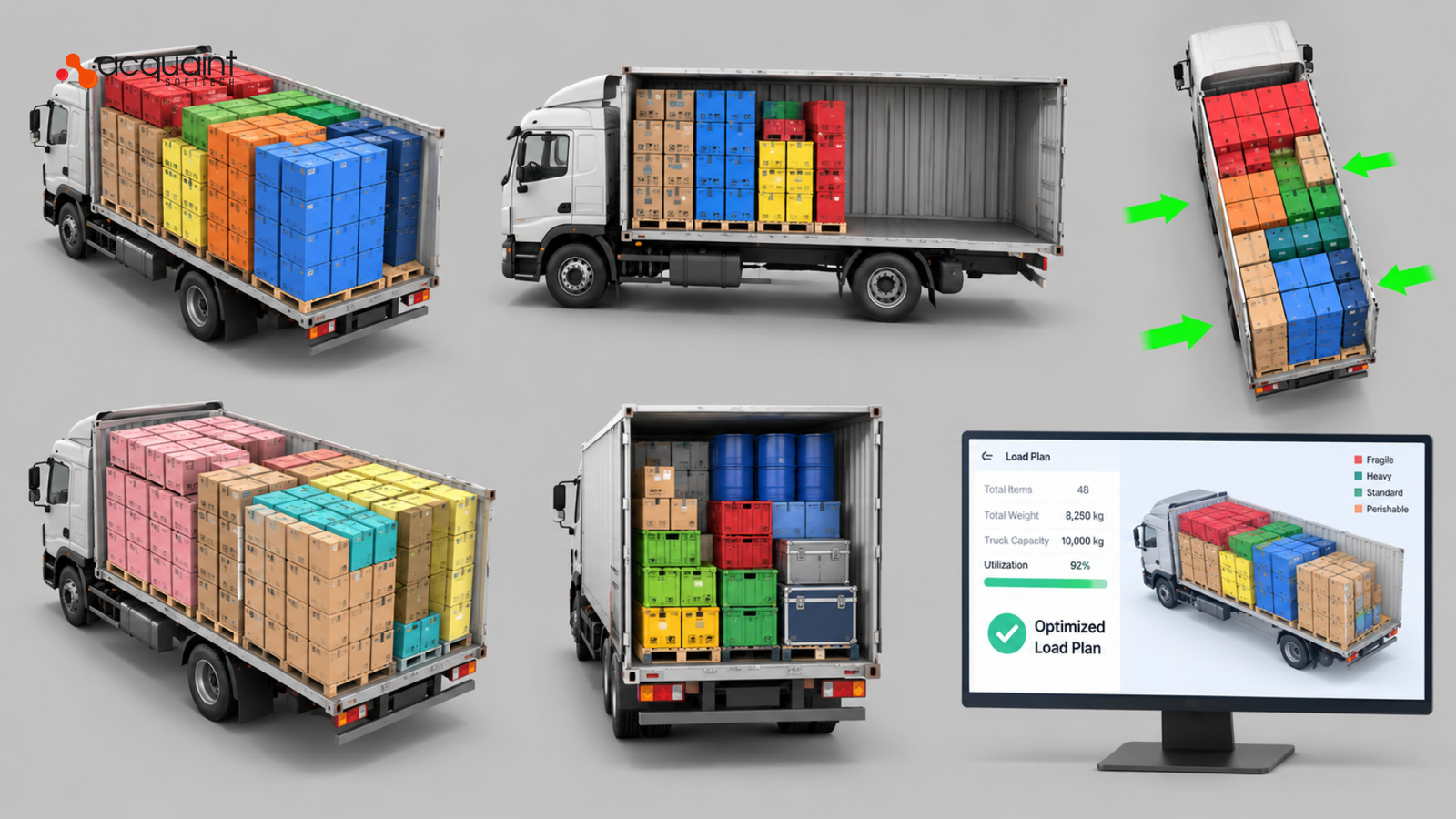
Load Planning and Optimization: Algorithms for Maximizing Truck Utilization
As the Head of Business and Engineering at Acquaint Softtech, a partner for AI development services, I have seen trucks leave the dock half empty while a smarter arrangement of the same freight would have fit it all in one trip.
A truck load optimization algorithm fixes that by turning the messy Tetris of manual loading into structured math that maximises cube and payload within legal limits. This deep dive walks through the algorithms, constraints, architecture, and real build cost of load planning logistics done properly in software.
The stakes are physical and legal. On US Interstates the Federal Highway Administration caps a truck at 80,000 pounds gross, 20,000 on a single axle, and 34,000 on a tandem axle, and the Federal Bridge Formula can make a load illegal even under 80,000 pounds. Empty and partial trips are the other drain, with industry research putting empty miles at 20 to 35 percent of trucking miles. Truck load optimization exists to squeeze the most legal, safe payload into every trip, which is why weight volume constraint optimization sits at the centre of any serious build.
This is the transportation-layer companion to the Complete Guide to Logistics and Supply Chain Software Development in 2026, which covers TMS, WMS, and fleet builds in depth. It draws on real optimisation and routing modules Acquaint Softtech has shipped as an Official Laravel Partner, with 1,300+ projects, 70+ in-house engineers, and clients across the USA, UK, Europe, Australia, and New Zealand who deploy dedicated teams within 48 hours of brief.
What truck load optimization is
Truck load optimization is the use of algorithms to maximise a truck’s cargo space and payload while balancing axle weights and cutting cost, by arranging freight to minimise empty gaps and partially filled trips. It is both a volume problem, filling the cube, and a weight problem, using the legal payload, and a good optimizer solves both at once. In plain terms, it decides exactly what goes where in the trailer.
The output is a precise placement plan: every carton or pallet gets X, Y, Z coordinates inside the trailer, with weight balanced across axles and fragile items kept off the bottom of the stack. Because the answer must satisfy legal, physical, and route constraints at once, the right first step is scoping the rules that matter for your freight. A discovery workshop settles those rules before any algorithm is chosen.
How load planning works and why it is computationally hard
How load planning works in software is a search for the best placement of many items into a bounded space under constraints, which is a variation of the 3D bin packing problem and is classified as NP-hard. That means there is no known fast method to guarantee the perfect answer as item counts grow, so real systems aim for near-optimal solutions computed quickly. Understanding that trade-off is the whole game.
Bin packing for freight is deceptively hard because every item added multiplies the possible arrangements, and each arrangement must still pass weight, stacking, and sequence checks. A planner that brute-forces every option will never finish; a planner that guesses badly wastes space or breaks a rule.
The engineering job is to pick an algorithm that reaches a good answer in seconds, which is where an experienced software product development team earns its keep. Shipment data itself often originates in a storefront, so teams hire WooCommerce developers or hire WordPress developers to feed accurate dimensions and weights into the planner.
What algorithm for load optimization: bin packing, heuristics, and MILP
The three algorithm families used for load optimization are exact 3D bin packing, heuristics and metaheuristics, and mixed-integer linear programming. Exact packing computes item coordinates to minimise gaps; heuristics find near-optimal patterns fast; MILP models the whole problem as maths and solves weight, stacking, and sequence together. Most production systems combine a fast heuristic with an optimisation solver.
| Approach | How it works | Best for |
| 3D bin packing | Computes X, Y, Z placement to minimise empty gaps | Precise cube utilisation |
| Heuristics and metaheuristics | Genetic algorithms, simulated annealing, tabu search | Fast near-optimal on complex item sets |
| Mixed-integer linear programming | Models weight, stacking, and sequence as constraints | Balancing many hard rules at once |
What algorithm for load optimization is right depends on scale and rule complexity: heuristics win when speed matters and item counts are high, while MILP wins when legal and stacking rules must be provably satisfied.
In practice a hybrid runs a metaheuristic to get a strong candidate, then refines it with a solver. This model and solver work is built by our hire AI/ML engineers, and the surrounding service is owned by a dedicated development team.
Modeling the constraints: weight, axle, stacking, and unloading
A load optimizer is only useful if it respects the constraints a real truck faces: legal weight and axle limits, physical stacking rules, and the unloading sequence. These are not soft preferences; a plan that violates them is unusable or illegal. Weight volume constraint optimization means the algorithm treats these as hard limits, not afterthoughts.
| Constraint | What it enforces | Why it matters |
| Weight and axle limits | Gross and per-axle legal limits | Avoids fines and unsafe loads |
| Physical stacking rules | Fragile off the bottom, max stack height | Prevents damage and collapse |
| Unloading sequence | First drop-off loaded last, near the door | Fast multi-stop unloading, no reshuffling |
The unloading sequence constraint is what separates a toy packer from a real one: for a multi-stop route, the first delivery must be reachable without moving the rest of the load.
Encoding these rules cleanly, as validators the optimizer must satisfy, keeps the system correct as rules change. That rules-and-validation layer is commonly built when teams hire Laravel developers, and teams that need to add constraint-modelling skill fast use IT staff augmentation.
Building a truck load optimization algorithm in Python
Python is the practical language for a truck load optimization algorithm, because its optimisation ecosystem is mature and mostly free. A common approach pairs a free 3D bin packing library for placement with Google OR-Tools for the constraint and weight-balancing model. You start with a heuristic packer to get a working plan, then add solver-based refinement as the rules grow.
| # free truck load optimization algorithm example (py3dbp)from py3dbp import Packer, Bin, Item packer = Packer()# 53 ft trailer: length, width, height (in), max payload (lb)packer.add_bin(Bin(‘trailer-53ft’, 636, 102, 110, 45000)) packer.add_item(Item(‘pallet-A’, 48, 40, 60, 800))packer.add_item(Item(‘pallet-B’, 48, 40, 48, 650))# …add every carton or pallet with real dimensions and weight packer.pack(bigger_first=True, distribute_items=True) for b in packer.bins: print(b.name, ‘fitted:’, len(b.items), ‘unfit:’, len(b.unfitted_items)) |
A minimal truck load optimization algorithm Python example using the free py3dbp library; add OR-Tools for weight and sequence constraints.
This example fills the cube; a production system adds axle-weight balancing, stacking validators, and the unloading sequence on top, usually with OR-Tools. Keeping the solver, the API, and the rules cleanly separated is what lets the tool evolve without a rewrite.
The service layer around the algorithm is built when teams hire Python developers or hire Django developers, and the output is regression-tested against real loads when teams hire automation engineers.
3D load planning software and visualization
What is 3D load planning? It is load optimization that treats the trailer as a three-dimensional space and shows the result as a rotatable 3D model, so planners can see and trust the plan before anyone touches a pallet. Good 3D load planning software turns coordinates into a picture: which item sits where, at what height, against which wall. Visualisation is what gets the plan actually followed on the dock.
The 3D view is a rendering job on top of the optimizer’s output, usually in the browser with WebGL, plus a simple loader-facing screen for the warehouse floor.
The web dashboard and 3D viewer are commonly built when teams hire MERN stack developers, and a driver or loader mobile app is built when teams hire React Native developers. A clear visual is the difference between a plan that is followed and one that is ignored.
Load optimizer architecture inside your TMS
A load optimizer belongs inside your TMS as a clean, callable service: orders and item dimensions go in, an optimised placement plan and 3D view come out, and the TMS handles everything else. Keeping the optimizer as its own service means you can scale it, swap the algorithm, and reuse it for container load optimization without touching the rest of the platform. This is the same modular pattern that keeps large logistics systems maintainable.
The service exposes an API the TMS calls at planning time, caches results, and logs every plan for audit and tuning.
Teams without an in-house function run the whole build through software development outsourcing, the compute and deployment are handled when teams hire DevOps engineers, and a legacy TMS is brought up to this modular shape first through a version upgrade.
How load optimization reduces cost and maximizes truck utilization
Load optimization reduces cost in three ways: higher cube and weight utilisation per truck, fewer total trips and empty miles, and less product damage in transit. Fewer, fuller trucks mean lower fuel, labour, and carrier spend, and a balanced load protects the freight. To maximize truck utilization you optimise for both volumetric space and legal payload together, not one at a time.
The gains compound: a few percentage points of extra cube utilisation across thousands of loads removes whole trucks from the schedule. The metric to watch is the load-to-truck ratio and the fill rate per trip, tracked on a live dashboard so planners see the effect of each change. That reporting layer is commonly built when teams hire MEAN stack developers, turning optimisation output into numbers the business can act on.
What a custom load optimizer costs to build
A focused truck load optimization tool with 3D bin packing and basic constraints typically costs $40,000 to $70,000 (about £32,000 to £56,000 or €37,000 to €65,000), a full optimizer with MILP constraint solving, a 3D viewer, and TMS integration runs $80,000 to $160,000, and an AI-driven, continuously learning system costs more.
For teams in the USA, UK, Europe, Australia, and New Zealand, the load optimization software cost is driven by constraint complexity, integrations, and scale, and it is almost always recovered in reduced trips and fuel.
| Build scope | USD | GBP | EUR | Timeline |
| Core packer with basic constraints | $40,000 to $70,000 | £32,000 to £56,000 | €37,000 to €65,000 | 3 to 5 months |
| Full optimizer, 3D viewer, TMS integration | $80,000 to $160,000 | £64,000 to £128,000 | €74,000 to €148,000 | 5 to 9 months |
| AI-driven, continuously learning system | $160,000+ | £128,000+ | €148,000+ | 8 to 12 months |
Building with a Clutch-verified India-based team keeps a custom truck utilization tool at $25 to $49 per hour, up to 40 percent below Western agency rates, so these ranges hold rather than balloon.
Teams that want a full managed build hire remote developers, while those who need only technical leadership add a virtual CTO. Budget per phase, packer first then constraints and 3D, so value lands before the full spend.
How to hire developers for load planning
To hire developers for load planning, look for a team that has shipped real optimisation under hard constraints, not just CRUD apps, because the value is in the algorithm and the rules engine.
The specialist skills are 3D bin packing and MILP, constraint modelling, and clean service architecture. Most companies either outsource the whole build or augment a small core team with these specialists.
| Model | Best for | What you get |
| Outsourcing | No in-house engineering | A full managed optimizer build |
| Staff augmentation | A lean tech team | Optimisation and constraint specialists |
| Hybrid | Scaling operations | In-house control plus a vendor bench |
Teams with a technical lead can hire project managers and specialist engineers on demand, with vetted people deployed within 48 hours, and keep the optimizer accurate after launch with ongoing support and maintenance. Agencies that resell a load-planning product under their own brand build it through white label development.
Whichever model you choose, keep control of the constraint rules and accuracy targets rather than handing everything over. Team stability matters more than a low hourly rate, because the engineers who tune your packing heuristics and validators are the ones who should refine them as your freight and rules change. That continuity is why Acquaint Softtech keeps the same core team on a platform from first release through scale.
See also: Duluth MN Website Design: What Makes a Strong Business Site
Frequently asked questions
What algorithm for load optimization?
The main algorithms are 3D bin packing for precise placement, heuristics and metaheuristics such as genetic algorithms, simulated annealing, and tabu search for fast near-optimal results, and mixed-integer linear programming to satisfy weight, stacking, and sequence rules together. Most production systems combine a fast heuristic with a solver, because the underlying 3D bin packing problem is NP-hard.
What is load optimization?
A: Load optimization is arranging freight, whether cartons, pallets, or full truckloads, in the most efficient and legal way possible: maximising space and payload, protecting goods, and reducing cost while meeting delivery rules. Load optimization is the strategy, and load planning is the execution that assigns specific items to specific positions in the vehicle.
How to maximize truck utilization?
A: Maximize truck utilization by optimising for volumetric space and legal payload at the same time, not one at a time, and by consolidating shipments to avoid partially filled trips. A 3D load optimization algorithm computes item placement to fill the cube while balancing axle weights, and tracking fill rate and the load-to-truck ratio shows where utilisation can still improve.
What is 3D load planning?
3D load planning treats the trailer or container as a three-dimensional space and computes X, Y, Z coordinates for each item, then shows the result as a rotatable 3D model. It lets planners see exactly how freight fits, spot problems before loading, and give the dock a plan they can follow, which is why 3D load planning software adoption keeps rising.
How does load optimization reduce costs?
Load optimization reduces costs by fitting more freight into fewer trucks, which lowers fuel, labour, and carrier spend, and by cutting empty miles through consolidation and backhaul planning. Balanced, well-stacked loads also reduce product damage and returns. Small gains in cube utilisation compound across thousands of loads into whole trucks removed from the schedule.
What are the logistic optimization techniques?
Common logistics optimization techniques include 3D bin packing and cartonization for loading, route optimization for delivery, freight or load consolidation to combine shipments, and constraint-based methods such as mixed-integer linear programming. Metaheuristics like genetic algorithms and simulated annealing are used when problems are too large to solve exactly in the available time.
How to calculate load to truck ratio?
The load-to-truck ratio is the number of available loads divided by the number of available trucks in a market or lane, a demand-versus-capacity measure used on freight load boards. A ratio above one means more loads than trucks, which favours carriers on rates; below one favours shippers. It is a market indicator, distinct from a single truck’s fill rate or cube utilisation.
What technique optimizes transportation by combining shipments into truckloads?
Load or freight consolidation is the technique that combines multiple smaller shipments into fuller truckloads, reducing the number of trips and cost per unit shipped. It is often paired with multi-stop route planning and zone skipping, and a load optimization algorithm decides how the consolidated freight is arranged to stay within weight and stacking limits.